This past Saturday, the amphitheater at Philip S. Miller Park closed out its milestone tenth season with a Bob Seger tribute from the Denver Pops Orchestra, and the parking lot looked the way it had looked most Saturday nights since May: full, loud, lit up. Within the week, the splash pad shuts off for the year, right around Labor Day, the way it does every summer. If you only know the park from those two things, the concerts and the splash pad, you'd guess the park is winding down.
It isn't. It's switching identities. The version of Philip S. Miller Park that draws crowds and the version that's actually good to use are two different parks running on two different clocks, and this is the week they trade places.
What Just Went Dark
The splash pad typically runs Memorial Day through Labor Day, weather permitting, and this is the year that pattern holds again. The amphitheater's summer concert series, which just wrapped its tenth anniversary run, brought bigger acts than usual this year, Fitz and the Tantrums on Colorado Day, Jackson Dean and Tigirlily Gold in July, Cheap Trick in mid-August, which meant bigger crowds than the venue's usual nine seasons. If Philip S. Miller Park has felt more crowded to you this summer than in past years, that's not a feeling. It's a milestone season doing what milestone seasons do.
Both of those draws are now closed or closing. What's left standing is everything that was never dependent on a concert calendar or warm-weather plumbing in the first place.
What Was Already There the Whole Time
The park is 300 acres, and the splash pad and amphitheater sit on a small fraction of it. The rest is an 8-mile native-surface trail network split into four interconnected loops, plus a separate mile of paved, accessible trail that circles the park. None of that closes for the season. None of it requires a ticket. Parking and admission have always been free.
A few numbers worth knowing if you haven't walked the far side of the park recently:
- The trail network's centerpiece, Challenge Hill, is a 200-step outdoor staircase that gains 178 feet of elevation in a short climb, tougher than it looks from the bottom.
- The 8-mile loop system is native surface, meaning dirt and rock rather than pavement, so footing changes with the season.
- The paved loop adds a full mile of flat, accessible trail for anyone who wants the park without the climb.
Weekday mornings are consistently the least crowded time to use any of this, which matters more in fall than it did in July, because fall is when the trails are actually at their best. Foliage along the loops peaks in late September and into October, right as the crowds that came for concerts and splash pad water stop showing up entirely.
That's the inversion. The two months when Philip S. Miller Park is least busy are the same two months when the trail system, which is most of the park's actual acreage, looks the best it's going to look all year.
The Staircase Habit
Challenge Hill isn't hidden. Most people who live near the park have seen it, and a fair number have climbed it once, usually in summer, usually assuming it's a warm-up. It's 200 steps and 178 feet of gain, and it earns its name the second the incline shows up. It's the kind of thing you either avoid after one attempt or come back to on purpose.
What changes in fall isn't the staircase. It's the conditions around it. Summer mornings at Challenge Hill mean heat building fast and a lot of company, since the same crowd that packed the amphitheater lot on weekends also tends to treat the staircase as a photo-op stop before splash pad time. Cooler fall mornings mean fewer people arriving at 9 a.m. because there's no reason left to be at the park unless the staircase itself is the reason. If you've been meaning to make Challenge Hill an actual habit instead of a once-a-summer dare, the next several weeks are the window where the weather cooperates and the crowd doesn't compete with you for the steps.
The Part of the Park That Doesn't Care About Labor Day
A few features at Philip S. Miller Park were never seasonal in the first place, and they're worth knowing about specifically because most residents only think about them once the weather turns.
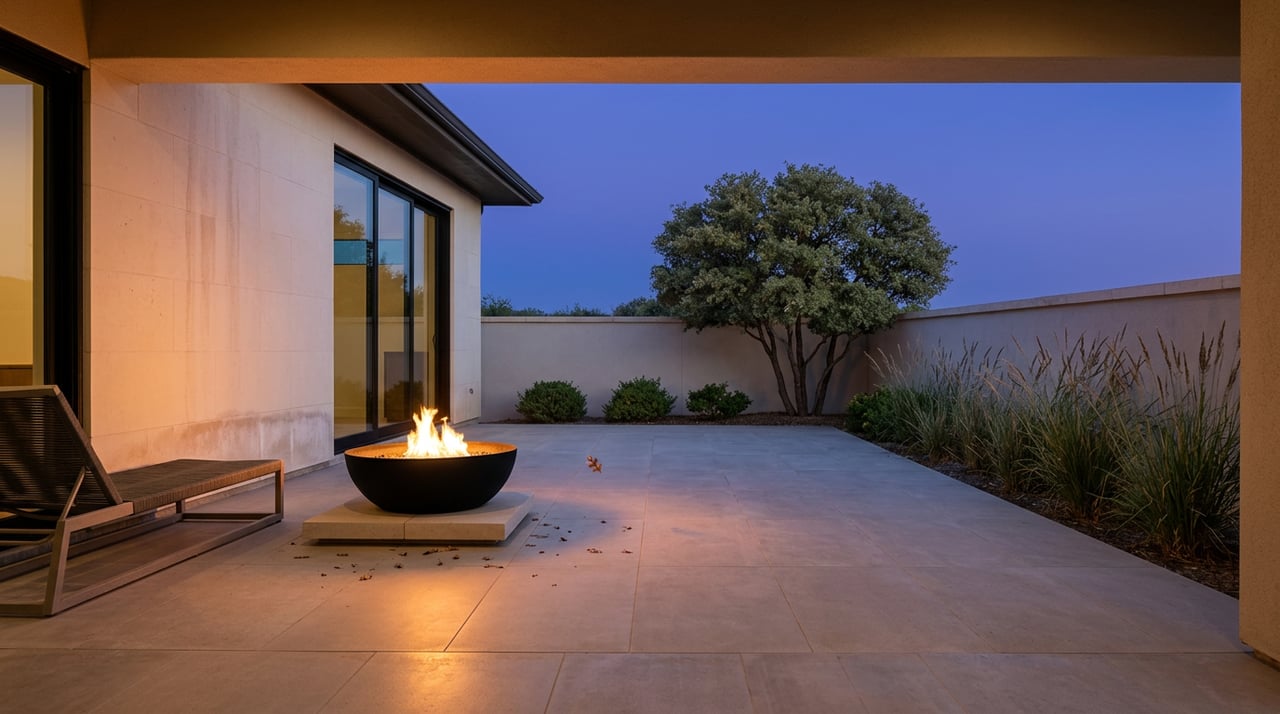
Two gas fire pits run daily from 7 a.m. to 10 p.m., located in pavilions one and two. In July, nobody's building a fire pit night into their plans, the whole park is already outdoors and warm. By late September, with the sun going down earlier and the temperature dropping fast after dark, those fire pits go from an amenity nobody notices to one of the more useful reasons to be at the park after dinner.
The Millhouse sits next to the amphitheater, a special events building with floor-to-ceiling windows and high wooden beams, and its patio wraps around an outdoor fireplace overlooking the park's pond and waterfalls. It's built for exactly the kind of evening that's coming, cool enough for a fire, still comfortable enough to sit outside.
The EDGE, the park's zipline and adventure operation, runs a separate set of attractions entirely: ziplines, the Sky Trek course, the Adventure Tower, and a Ninja Course, all through a public-private partnership with the town. None of it is tied to the splash pad's Memorial Day to Labor Day clock. If you've written it off as a summer thing because it sits near the water feature, it isn't one.
The Actual Point
None of this is a secret the town is keeping. It's on the park's own page, it's in the splash pad's posted season, it's in the numbers on the Challenge Hill sign. The gap isn't information, it's habit. Three months of concert traffic and splash pad crowds train residents to associate the park with noise and lines, and then the noise stops and a lot of people mentally file the park as done for the year, right when the part of the park that was always the point, the trails, the staircase, the fire pits, the quiet, is just getting good.
If you live near Philip S. Miller Park, the next six to eight weeks are worth treating as a separate season rather than a wind-down. Weekday mornings on the loops. An evening at a fire pit instead of inside. One more run at the 200 steps, this time without the July heat working against you.
That's the kind of detail about a neighborhood that doesn't show up on a map or a listing sheet, and it's exactly the kind of thing REBL Home Team pays attention to, because knowing how a place actually gets used day to day is a different skill than knowing what it's worth. If you're already living the Castle Rock version of fall and you ever want to talk about what that same local knowledge means for your home's value or your next move, we're a phone call away.